


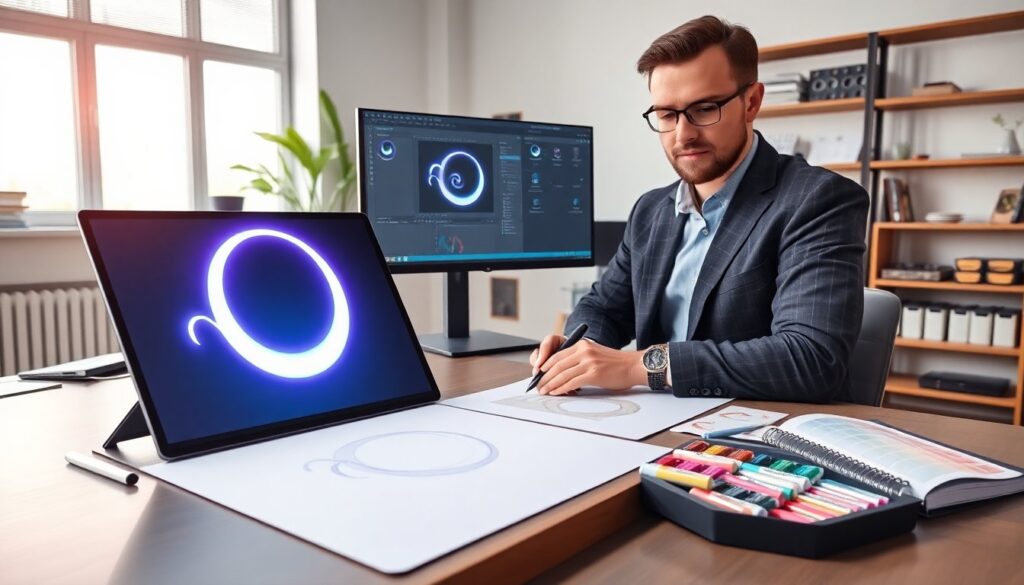
Avstarnews.com appears as a glowing, curvilinear script. The topic mixes art, fiction, and design. The article explains origin clues, visual traits, and steps to design Austarglow. The reader will learn clear techniques and short practice projects.
Key Takeaways
- Austarglow alien calligraphy is a glowing, curvilinear script inspired by cursive, runes, and neon signage, primarily used in fan art and indie game design.
- The signature visual traits include flowing strokes with bright white cores and soft colored halos in cyan, magenta, and violet to create an otherworldly glow effect.
- Creating Austarglow designs involves starting with seed shapes, linking strokes, adding thickness contrasts, and layering white cores with halos to maintain rhythm and balance.
- Artists use specific tools like acrylic inks, neon markers, pressure-sensitive tablets, and vector software to achieve authentic glow effects digitally and physically.
- Practice exercises such as seed variations, core and halo painting, and small-scale legibility tests build consistency and confidence in the Austarglow style.
Origins, Inspiration, And Cultural Context Of Austarglow
Austarglow alien calligraphy began as a fan-made aesthetic in online forums. Writers and artists created the script for sci-fi fanzines and game mods. The script borrowed shapes from cursive, runes, and neon signage. Designers used the term Austarglow to signal an otherworldly light effect. Scholars do not record any historical language named Austarglow. Creators cite film props, retro arcade art, and platformer visuals as influence. The team behind some game art referenced a development interview for inspiration in similar projects, as seen in a Hirogami interview. Fans assigned cultural meaning to symbols. Groups used symbols as logos, tattoos, and stream overlays. The script gained use in fan art and indie game assets. The community kept the style open and iterative. The style remains largely decorative rather than linguistic.
Visual Characteristics, Materials, And Tools For Authentic Austarglow Style
Austarglow alien calligraphy uses flowing strokes and bright cores. Lines often vary from thin to thick. Artists place a soft halo around strokes to make them glow. The palette favors cyan, magenta, and warm violet. The forms combine circular loops and angular terminals. Artists replicate the glow with layered paint or digital blur. For physical work, artists use acrylic inks, neon markers, and metallic gouache. They apply a white core and glaze with translucent color. For digital work, designers use vector strokes, outer glow effects, and gradient overlays. They export at high resolution to retain halo detail. Tools include brush pens, chisel tips, pressure-sensitive tablets, and vector software. A designer selects paper with smooth texture for wet media. They choose screen color profiles for accurate neon hues. The visual rules remain simple: contrast core and halo, keep stroke rhythm, and balance loops with points. Observers recognize Austarglow alien calligraphy by its bright center and soft edge.
Step-By-Step Guide To Designing Your Own Austarglow Symbols
Austarglow alien calligraphy design starts with basic marks. The artist draws a seed shape. The artist repeats the shape with small changes. The artist links seeds with connecting strokes. The artist defines a thick main stroke and a thin hairline. The artist adds a white core. The artist paints a halo around the core. The artist repeats the pattern across a word or emblem. The artist refines spacing to avoid visual crowding. The artist tests legibility at small scales. The artist then applies color gradients to suggest depth. The artist exports a high-resolution PNG for overlays. The artist versions the symbol for dark and light backgrounds. The artist documents stroke order to keep consistency. The next section gives short exercises to build speed and confidence.
Practice Exercises And Quick Projects To Master Austarglow Forms
Exercise 1: Seed Variations. The artist draws one seed shape ten times. The artist alters angle, loop size, and terminal. The artist keeps stroke rhythm constant. Exercise 2: Core and Halo. The artist draws five strokes and fills a white core in each. The artist paints two halo widths for comparison. Exercise 3: Rhythm Chains. The artist links four seeds into a chain. The artist balances positive and negative space. Exercise 4: Color Swap. The artist renders one symbol in three palettes: cyan, magenta, violet. Exercise 5: Small-Scale Test. The artist reduces the symbol to icon size and checks clarity. Quick Project A: Stream Overlay Word. The artist composes a short word and exports a glowing PNG for a broadcast overlay. Quick Project B: Sticker Set. The artist creates three symbols as sticker art and prepares them for print. Quick Project C: Avatar Emblem. The artist adapts one symbol into a circular emblem and tests it on light and dark backgrounds. The exercises favor repetition and simple judgment. They help the artist build consistent stroke shapes and glow treatment.

